How to change the directory in Python
Learn how to change directory in Python. This guide covers various methods, tips, real-world uses, and how to debug common errors.
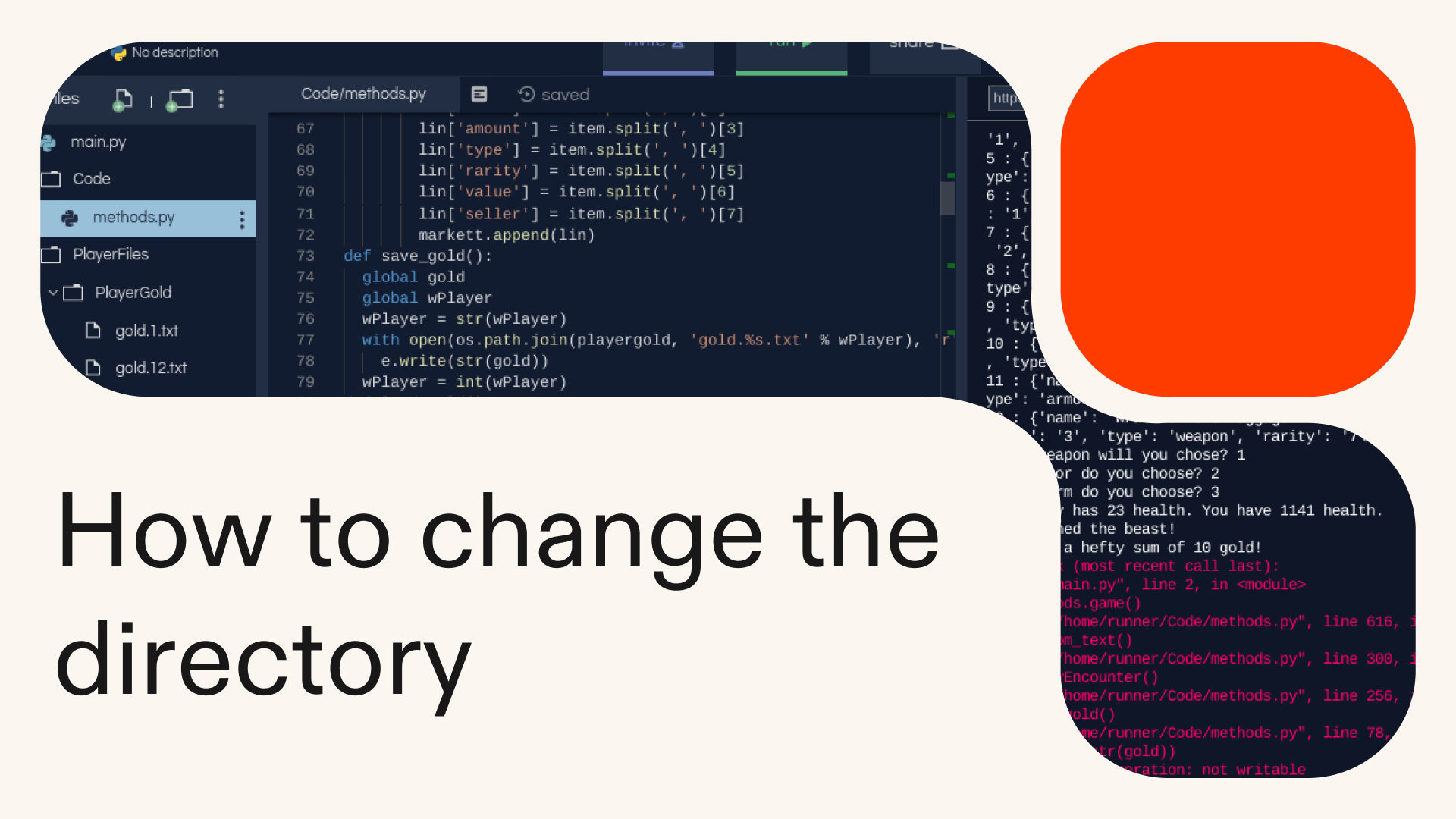

To navigate your file system, you need to change the current working directory in Python. This lets your scripts interact with files and folders in different locations, a crucial skill for automation.
In this article, we'll cover several techniques to change directories. You'll find practical tips, see real-world applications, and get advice to debug common issues so you can manage file paths effectively.
Using os.chdir() to change directory
import os
print(f"Current directory: {os.getcwd()}")
os.chdir('/tmp')  # Change to the /tmp directory
print(f"New directory: {os.getcwd()}")--OUTPUT--Current directory: /home/user
New directory: /tmp
The os module is Python's standard tool for interacting with the operating system. Its primary function for changing directories is os.chdir(), which takes a string path as its argument. The example uses an absolute path, '/tmp', to navigate directly to that specific folder.
Notice how the code calls os.getcwd() both before and after the change. This isn't just for demonstration; it's a crucial debugging practice for getting current working directory in Python. Verifying the current directory ensures your script reads from and writes to the correct location, which helps you avoid path-related errors down the line.
Common directory operations
While os.chdir() gets the basic job done, you'll need more robust tools for building paths and managing directories in your scripts.
Using os.path.join() for platform-independent paths
import os
parent_dir = os.path.dirname(os.getcwd())
print(f"Current directory: {os.getcwd()}")
os.chdir(os.path.join(parent_dir, "documents"))
print(f"Changed to: {os.getcwd()}")--OUTPUT--Current directory: /home/user/downloads
Changed to: /home/user/documents
Hardcoding paths with slashes or backslashes can break your script on different operating systems. The os.path.join() function solves this by creating a valid path string for you, regardless of whether the code runs on Windows, macOS, or Linux. It intelligently adds the correct separator.
- In the example,
os.path.dirname()first gets the parent of the current directory. - Then,
os.path.join()combines that parent path with the "documents" folder to create a full, reliable path.
This approach makes your code more portable and memory-efficient when navigating the file system.
Temporarily changing directory with context manager
import os
from contextlib import contextmanager

@contextmanager
def change_dir(path):
    old_dir = os.getcwd()
    os.chdir(path)
    try:
        yield
    finally:
        os.chdir(old_dir)

with change_dir('/tmp'):
    print(f"Inside context: {os.getcwd()}")
print(f"After context: {os.getcwd()}")--OUTPUT--Inside context: /tmp
After context: /home/user
Sometimes you only need to change the directory for a small part of your script. A context manager is perfect for this because it automatically handles the cleanup, ensuring your script returns to its original directory after the temporary operations are complete.
- The custom
change_dirfunction uses the@contextmanagerdecorator to create this temporary context. - Inside the
withblock, your code runs in the new directory you specified, like'/tmp'. - The
finallyclause is key—it guarantees thatos.chdir()restores the original directory, even if an error occurs.
Creating and navigating to new directories
import os
new_dir = os.path.join(os.getcwd(), "new_folder")
if not os.path.exists(new_dir):
    os.mkdir(new_dir)
os.chdir(new_dir)
print(f"Now in newly created directory: {os.getcwd()}")--OUTPUT--Now in newly created directory: /home/user/new_folder
Your scripts can also create new directories before navigating into them—a common pattern for organizing output files or logs. The key is to perform this action safely to avoid errors, using proper techniques for creating directories in Python.
- First, the code checks if the directory already exists using
os.path.exists(). - If the directory is missing,
os.mkdir()creates it. This check prevents your script from crashing if the folder is already there. - Finally,
os.chdir()changes the current working directory to the new folder, whether it just created it or not.
Advanced directory techniques
As your scripts grow more complex, you'll need more than the standard os functions, making modern tools like pathlib and advanced pathing concepts essential.
Using pathlib for modern directory handling
from pathlib import Path
import os
current = Path.cwd()
print(f"Current: {current}")
os.chdir(current.parent)
print(f"Changed to parent: {Path.cwd()}")--OUTPUT--Current: /home/user/documents
Changed to parent: /home/user
The pathlib module offers a modern, object-oriented way to handle filesystem paths. Instead of working with simple strings, you get Path objects that have useful methods and attributes, making your code more readable.
- The example uses
Path.cwd()to get the current directory as aPathobject. - You can then access its
.parentattribute to easily find the parent directory—a cleaner alternative toos.path.dirname(). - This object-oriented approach simplifies path manipulation before you finally change the directory with
os.chdir().
Navigating with relative and absolute paths
import os
print(f"Current: {os.getcwd()}")
# Change to absolute path
os.chdir('/usr/local')
print(f"Changed to absolute path: {os.getcwd()}")
# Change to relative path
os.chdir('../bin')
print(f"Changed to relative path: {os.getcwd()}")--OUTPUT--Current: /home/user
Changed to absolute path: /usr/local
Changed to relative path: /usr/bin
Your script can navigate using two types of paths. An absolute path is a complete address starting from the root directory, while a relative path is based on your current location.
- Absolute paths like
'/usr/local'are unambiguous. They point to the same folder regardless of your script's current directory. - Relative paths such as
'../bin'are context-dependent. The..operator moves up one level, so from/usr/local, the script navigates to thebinfolder inside/usr.
Thread-safe directory changes with os.chdir()
import os
import threading

def thread_function(directory):
    print(f"Thread before: {os.getcwd()}")
    os.chdir(directory)
    print(f"Thread after: {os.getcwd()}")

thread = threading.Thread(target=thread_function, args=('/tmp',))
thread.start()
thread.join()
print(f"Main thread directory: {os.getcwd()}")--OUTPUT--Thread before: /home/user
Thread after: /tmp
Main thread directory: /home/user
Using os.chdir() in a multithreaded script requires careful management. The function modifies the current working directory for the entire process, but its effects can appear isolated depending on the operating system and timing.
- In this example, a new thread successfully changes its directory to
'/tmp'. - However, once the thread finishes, the main thread's directory remains unaffected.
This demonstrates a behavior where threads don't interfere with each other's paths, which is crucial for preventing race conditions where one thread's actions unintentionally disrupt another's.
Move faster with Replit
Replit is an AI-powered development platform that comes with all Python dependencies pre-installed, so you can skip setup and start coding instantly. Instead of just piecing together techniques like os.chdir(), you can use Agent 4 to build complete applications from a simple description. It handles the code, databases, APIs, and deployment for you.
For example, you could ask the Agent to build practical tools that manage files and directories:
- A file cleanup utility that scans a directory, sorts files by their extension, and moves them into corresponding folders.
- A project setup script that automatically generates a new folder structure with subdirectories for source code, tests, and assets.
- A data backup tool that navigates to a specific folder, archives its contents, and saves the compressed file to a separate backup directory.
Simply describe your app, and Replit will write the code, test it, and fix issues automatically, all within your browser.
Common errors and challenges
Changing directories seems simple, but a few common pitfalls can easily trip up your scripts and cause unexpected, hard-to-debug errors.
Handling non-existent directories with os.chdir()
If you use os.chdir() to navigate to a directory that doesn't exist, your script will immediately crash with a FileNotFoundError. This is a frequent issue, especially when paths are generated dynamically or provided by a user. To build more robust code, you should always confirm a directory exists before attempting to change into it. A quick check with os.path.exists() before you call os.chdir() is all it takes to prevent this error.
Understanding relative path confusion with .. notation
Relative paths that use the .. operator to move up a level can be a source of confusion because they depend entirely on the current working directory. If your script isn't in the directory you think it is, a path like ../data will point to the wrong location, causing your program to fail when it can't find expected files. When in doubt, use os.getcwd() to print your current location for debugging, or stick to absolute paths for critical file operations to ensure your script is always looking in the right place.
Preventing directory leaks in functions
When a function changes the directory but fails to change it back, it causes a "directory leak." This side effect means any code that runs after the function call will execute from an unexpected location, leading to bugs that are difficult to trace. The most reliable way to avoid this is with a context manager, which guarantees the original directory is restored once the block is complete. A simple try...finally block also works well—it ensures os.chdir() is called to return to the starting path, even if an error occurs inside the function.
Handling non-existent directories with os.chdir()
Attempting to change into a directory that doesn't exist is a guaranteed way to stop your script in its tracks. When os.chdir() can't find the specified path, it raises an error. The code below shows this exact scenario in action.
import os
# This will crash if the directory doesn't exist
os.chdir('/path/that/doesnt/exist')
print(f"Current directory: {os.getcwd()}")
The code calls os.chdir() on a hardcoded, non-existent path, which guarantees a FileNotFoundError and stops the script. The example below demonstrates a more robust way to handle this common scenario and avoid the crash.
import os
try:
    os.chdir('/path/that/doesnt/exist')
    print(f"Current directory: {os.getcwd()}")
except FileNotFoundError:
    print("The directory does not exist!")
    # Continue with fallback logic
This improved version wraps the os.chdir() call in a try...except block. If the directory is missing, Python raises a FileNotFoundError, which the except block catches. Instead of crashing, the script prints a helpful message and can continue running. This is crucial when working with paths from user input or configuration files, as you can't always guarantee they'll be valid. It makes your code far more resilient and amenable to automated code repair.
Understanding relative path confusion with .. notation
Using the .. operator for relative paths can be tricky since it's entirely dependent on your current directory. If your script isn't where you expect, a path like ../downloads will lead you astray. The following code demonstrates how this common mix-up happens.
import os
# Starting in /home/user
os.chdir('documents')
os.chdir('../downloads')  # Trying to go to /home/user/downloads
print(f"Current directory: {os.getcwd()}")
The script first changes into the documents directory. The subsequent chdir('../downloads') command then navigates relative to this new location, not the original directory—an easy mistake to make. The following example shows how to prevent this mix-up.
import os
# Starting in /home/user
starting_dir = os.getcwd()
os.chdir('documents')
# Go back to the parent and then to downloads
os.chdir(os.path.join(os.path.dirname(os.getcwd()), 'downloads'))
print(f"Current directory: {os.getcwd()}")
This solution prevents errors by building a more explicit path. It uses os.path.dirname(os.getcwd()) to get the parent of the current directory, then safely combines it with the target folder using os.path.join(). This approach is far more reliable than using the .. operator, especially in scripts that navigate through multiple directories, because it constructs the path from a predictable starting point instead of relying on relative context.
Preventing directory leaks in functions
If a function changes the directory and doesn't change it back, it causes a "directory leak." This side effect means code running after the function executes from an unexpected location, leading to hard-to-trace bugs. The following code demonstrates this common error.
import os

def process_files(directory):
    os.chdir(directory)
    # Process files in the directory
    print(f"Processing in: {os.getcwd()}")
    # No return to original directory!

process_files('/tmp')
print(f"Current directory is now: {os.getcwd()}")  # Still in /tmp!
The process_files function changes the directory but doesn't restore the original path, leaving the script in an unexpected location. The following example demonstrates a reliable way to contain the directory change within the function.
import os

def process_files(directory):
    original_dir = os.getcwd()
    try:
        os.chdir(directory)
        # Process files in the directory
        print(f"Processing in: {os.getcwd()}")
    finally:
        os.chdir(original_dir)

process_files('/tmp')
print(f"Current directory is still: {os.getcwd()}")  # Original directory
This solution uses a try...finally block to prevent directory leaks. It saves the original directory before changing it. The finally clause guarantees that os.chdir() restores the starting path, even if an error occurs during file processing. This pattern is essential for any function that temporarily changes the current working directory, ensuring your script's state remains predictable and avoiding hard-to-trace bugs in subsequent code.
Real-world applications
Beyond just avoiding errors, changing directories is fundamental to building practical automation scripts that manage files and organize project structures.
Batch processing files with os.walk()
The os.walk() function is a powerful tool for recursively scanning a directory tree, making it ideal for finding and processing files in bulk across multiple subfolders.
import os

def process_text_files(root_dir):
    original_dir = os.getcwd()
    for dirpath, _, filenames in os.walk(root_dir):
        os.chdir(dirpath)
        text_files = [f for f in filenames if f.endswith('.txt')]
        for file in text_files:
            print(f"Processing {file} in {dirpath}")
    os.chdir(original_dir)

process_text_files('/home/user/documents')
This function shows a practical way to handle files scattered across many folders. It uses os.walk() to step through a directory tree, and for each folder it finds, it temporarily changes the working directory into it with os.chdir(). This pattern simplifies file operations inside the loop and complements techniques for creating files in Python.
- The script then uses a list comprehension to find all files ending with
.txt. - After processing the files in each subfolder, it returns to the original directory.
- This final step is crucial for preventing directory leaks.
Setting up project directories with Path
The Path object is ideal for automating your project setup, allowing you to create a root directory and standard subfolders like src, tests, and docs with a simple script.
import os
from pathlib import Path

project_dir = Path('/home/user/projects/new_app')
project_dir.mkdir(exist_ok=True)
os.chdir(project_dir)

for directory in ["src", "tests", "docs", "data"]:
    Path(directory).mkdir(exist_ok=True)

print(f"Created project structure at {project_dir}")
This script uses a mix of pathlib and os to build a project's directory structure. It first creates the main project folder using Path.mkdir() with exist_ok=True, which prevents errors if the directory is already there. The script then navigates into this new folder with os.chdir().
- Once inside, a loop creates standard subdirectories like
srcandtests. - Using
Path(directory).mkdir()within the loop makes the code clean and readable, as it operates relative to the new current directory, similar to how vibe coding emphasizes intuitive development.
Get started with Replit
Put your knowledge into practice. Describe a tool to Replit Agent like, "Build a script that organizes my downloads folder by file type," or "Create a backup utility that zips a project folder and moves it to an archive."
The Agent writes the code, tests for errors, and deploys your application. Start building with Replit.
Describe what you want to build, and Replit Agent writes the code, handles the infrastructure, and ships it live. Go from idea to real product, all in your browser.
Describe what you want to build, and Replit Agent writes the code, handles the infrastructure, and ships it live. Go from idea to real product, all in your browser.